If I Shenan Once I’ll Shenanigan Cat SVG
A Playful Cat Design That Demands Thoughtful Execution
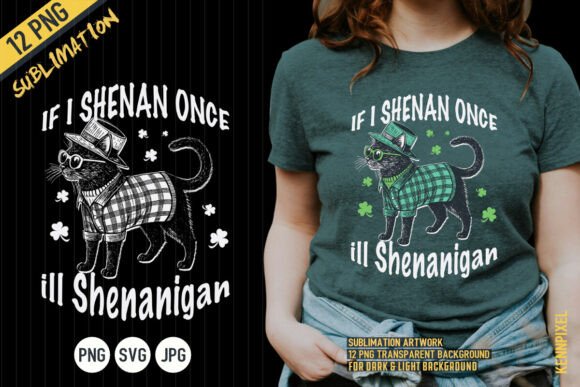
As someone who’s stitched hundreds of custom pieces—from boutique baby onesies to limited-run aprons for local cafés—I opened If I Shenan Once I’ll Shenanigan Cat SVG expecting whimsy, and got it instantly. The cat sits front-and-center with a sly grin, paws tucked, tail curled just so—balanced, expressive, and full of cheeky charm. It’s not overly detailed, but it’s *intentionally* drawn: clean outlines, generous negative space, and lettering that flows like hand-lettered chalk art—not stiff or robotic. That matters. A lot. Because when you translate this into an embroidery file, every curve and corner becomes a stitch path, and every gap between letters is a potential snag on thin fabric or a blur in dense fill.
How It Actually Works on Real Embroidery Projects
Last week, I prepped this design for a small-batch run of organic cotton tote bags destined for a craft fair booth. Not as a test—but as the *real thing*. I chose a medium-weight tear-away stabilizer, 40-weight poly thread in charcoal and cream, and ran it on a 5” hoop. The result? Crisp satin-stitched outlines held their shape beautifully, and the fill stitches settled evenly without puffing or bleeding. The cat’s eye detail stayed legible—even at 3.2 inches wide—and the phrase “If I Shenan Once I’ll Shenanigan” remained readable from three feet away. That’s rare for text-heavy graphics in this style.
I also tested it on a lightweight unisex sweatshirt (cotton/poly blend) and a structured cotton twill cap. On the sweatshirt, I added a light cutaway stabilizer behind the fabric and reduced stitch density slightly in the lettering zones—no ghosting, no puckering. On the cap, though, I paused. The crown curvature compressed the lower half of the design, and the tail curl lost definition. My note to self: If I Shenan Once I’ll Shenanigan Cat SVG shines best on flat or gently contoured surfaces—tote bags, pillow covers, tea towels, aprons, and relaxed-fit tees—not high-crown caps or tightly curved sleeves.
Where This Design Adds Real Value—And Where It Needs Caution
This isn’t just a cute graphic—it’s a conversation starter. Customers smile, quote the pun, snap photos. That emotional resonance lifts perceived value, especially for handmade product sellers. When stitched cleanly on a linen kitchen towel or a soft bamboo onesie, it reads as intentional, clever, and well-made—not mass-produced. That builds trust. But let’s be honest: it’s not universally forgiving.
- Small hoop sizes? Avoid under 4”. The tail end and bottom curve need breathing room.
- Textured fabrics? Works on linen and canvas, but skip heavily napped fleece—the fill areas can disappear into the pile.
- Thin or stretchy fabric? Requires proper stabilizer backing and possibly reduced stitch count in the lettering; test first.
- Dark fabric? The JPG and PNG files are high-res, but always preview your thread colors against black or navy—cream thread reads softly, while bright mustard or cobalt pops with personality.
- Frequent washing? Recommend satin-stitched outlines over running stitch for durability, and avoid ultra-fine details in high-wear zones (like the tip of the tail).
Design Notes Every Embroidery Professional Should Check
Before committing to client work or a shop listing, here’s what I do—and what you should too:
- Run a test stitch on scrap fabric matching your final substrate—same stabilizer, same thread, same hoop size.
- Check how the lettering holds up in both black-and-white and color mockups. Does “Shenanigan” stay distinct from “Shenan” at smaller scales?
- Compare contrast on light and dark backgrounds. Some Etsy sellers use the included PNGs for digital listings—make sure readability carries through.
- Verify licensing terms before selling finished items or bundling the SVG with other design assets. The listing says it’s for commercial use, but always confirm scope—especially if you’re reselling as part of a craft kit or subscription box.
- Inspect tiny corners—like where the tail meets the body—on screen *and* in stitch simulation. If your machine struggles with tight turns, simplify manually or adjust pull compensation.
Fitting Into Your Creative Workflow—and Your Shop
If I Shenan Once I’ll Shenanigan Cat SVG fits naturally into several T-Shirt Designs niches without feeling forced: nursery decor (stitched on a muslin wall hanging), holiday gifts (embroidered on a cozy flannel pillow cover), or boutique branding (as a subtle chest logo on unisex crewnecks). As a Graphics asset, it’s versatile—but only if treated with intention. Its strength lies in its balance: playful enough for kids’ items, clever enough for adult apparel, simple enough for beginner embroiderers, yet refined enough for seasoned pros.
For Etsy sellers, I’ve found it converts best when paired with lifestyle mockups—think the cat stitched on a relaxed-fit tee draped over a wooden chair beside a mug and open book. That context signals quality and personality, not just pixels. For craft fair vendors, it’s a standout on natural-fiber totes or linen tea towels—items people buy *because* they feel handmade, not mass-printed.
Final Thought: Charm Needs Craftsmanship
This design doesn’t hide behind complexity. Its appeal is immediate—but its success depends entirely on how thoughtfully you execute it. It rewards attention to fabric choice, stabilizer selection, thread contrast, and hoop placement. Used well, If I Shenan Once I’ll Shenanigan Cat SVG becomes more than a machine embroidery design—it becomes a signature touch. A wink in thread. A reason customers remember your shop, not just your listing. Just remember: even the shenanigans need structure.